Road to Marriage 2024
We are a German-Filipina couple (guy: German, girl: Filipina) who lives in the Philippines (Taguig City) permanently and we recently got civilly married in the Philippines (June 2024).
In Summary: We started to research about the requirements in January 2024. The German reached out via email to the Registry Office (Standesamt) in Frankfurt (last residence in Germany) and the Botschaft in Manila to get the requirements. The Filipina then gathered her requirements from the list of documents that might be needed for the "examination of documents" by the Botschaft. We were VERY lucky and thankful that the authorities decided to skip the document examination and got our Certificate of capacity to contract marriage (Ehefähigkeitszeugnis) and the corresponding Consular Certificate from the Botschaft much earlier. This allowed us to work on the Marriage License application in the Philippines immediately and got civilly married in 6 months.
As obtaining the documents and meeting the requirements to get civilly married was quite an arduous and sometimes complicated process, we wanted to share our experiences and some tips that may be helpful to others. Feel free to share shortcuts or tips yourself if you have any. This is our way of giving back to the various blogs and videos we also watched regarding a German-Filipino marriage.
General stuff and getting an overview
The first tip is rather obvious but also very important:
You should strategically choose who of you does the communication with third-parties in a given situation during this process and in which language you want to communicate.
In general, it obviously makes sense that the German partner communicates with the German authorities (in German) and the Filipina partner communicates with the Filipino authorities (in Tagalog). This helps to keep the terminology right (e.g. you do not accidentally get a wrong document or submit incorrect information just because of some faulty translation) and you will get better information from officers at these authorities as they are more at ease to speak/write in their native language. But sometimes it may make sense to switch and have the other partner do the talking to get the answers to your questions. In any case it pays off to do this strategically and to really use to your advantage that you are two people with different backgrounds.
In order to marry civilly you will need a Marriage License (not to be mixed up with a Marriage Contract that you sign on the wedding day or a Marriage Certificate that you get after you get married). This document is valid only for 120 days upon issuance. So you have to get married rather quickly after you get it.
In the beginning you should decide in which city you want to apply for the Marriage License. While the document requirements are largely the same, there are some smaller differences. We initially planned to make the application in Taguig City (where we live), so we checked with them to prepare our documents. However, rather last-minute, we decided to switch to Makati City, which turned out ok, but we would not recommend switching.
One of the partners has to be a resident of the city where you want to apply for your Marriage License. The Marriage License though is valid anywhere in the Philippines.
The document requirements for a Marriage License in Makati can be found here: https://www.makati.gov.ph/assets/uploads/staticmenu/docs/1581042114419.pdf (page 27).

The document requirements for a Marriage License in Taguig City can be found here: https://appointment.taguig.info/pub/?q=main (you have to start filling out the form and then the list appears):

Obtaining the documents
When you know what documents you need for a Marriage License you can get started collecting them.
In our case, both of us were not married before and we were over 25, so we did not need a Parental Advice/Consent document and furthermore no proof of annulment, divorce or the like. For all of the documents we had to provide 2 photo copies (besides the original copy) when applying for the Marriage License.
Certificate of capacity to contract marriage (Ehefähigkeitszeugnis) with Consular Certificate of Legal Capacity to Contract Marriage, as certified by the Filipino Department of Foreign Affairs (DFA)
This part is the most tedious and onerous to get as Germany and the Philippines are both extremely bureaucratic.
You will interact a lot with the German Registry Office (Standesamt) and the German embassy and both, in our experience, were really helpful. So if you are unsure about something, send them an email and ask your questions in advance so you do not lose time or make mistakes.
This also helps as you will build a “personal connection” with the officers and they will know your case in advance. The German embassy went above and beyond for us to help us with some of the requirements and we would like to think this is because we were able to build a good working relationship with them beforehand.
Certificate of capacity to contract marriage (Ehefähigkeitszeugnis)
So in order to get married in the Philippines the German partner has to get a Certificate of capacity to contract marriage (Ehefähigkeitszeugnis). The basic rule is that this is issued by the Registry Office (Standesamt) that is responsible for the city/district that you lived last in Germany.
In our case this was Standesamt Mitte in the city of Frankfurt (Main). They have a registration form that you have to fill out (https://frankfurt.de/service-und-rathaus/verwaltung/aemter-und-institutionen/standesamt/anmeldung-der-eheschliessung/heiraten-im-ausland), then you get a pdf via email with the document requirements and a case No.
This certificate is valid only for 6 months upon issuance and you have to get married within these 6 months.
It is very onerous to get this document because the Registry Office (Standesamt) checks not only if the German partner is free to marry, but also if the Filipina partner can be married by the German partner. As Germany does not trust Filipino documents, the Registry Office can request a document examination where the German embassy in Manila sends private investigators and other personnel to investigate if the information in the Filipino documents is actually correct (and you even have to pay for it). For more information about this process: https://manila.diplo.de/ph-en/service/verify-phl-docs/1691290).
We were lucky and the Registry Office (Standesamt) did not require this document examination, which saved a lot of time. According to the German embassy, it is currently discussed to abolish this document examination process, which may have played a role in why it was not requested in our case.
The documents to apply for a Certificate of capacity to contract marriage (Ehefähigkeitszeugnis) from the Registry Office in Frankfurt were the following (note that if you were previously married and/or you are a widow/widower, the requirements are probably a little bit different):
For the German partner
Proof of birth: Certified printout of the birth register with information section (Beglaubigter Ausdruck des Geburtenregisters mit Hinweisteil) - NOT a birth certificate (not older than 6 months). This was indeed rather tricky because the German authority sent this over to the Philippines via regular mail and without tracking. It got lost on the way and after some time passed we opted to just order it again to the German partner’s parents in Germany instead (who then sent it over via DHL Express).
Proof of residence: Current certificate of residence from the foreign residence authority or a utility bill (e.g. telephone, electricity etc.). We provided a Barangay Certificate from Taguig here. To obtain a Barangay Certificate, you have to get a Certificate of Residence from your own building association first. Both of us live in Barangay Fort Bonifacio. You can apply here online for a Barangay Certificate: https://www.barangayfortbonifacio.com/online-services. This is then issued as a pdf that is sent to you. You have to have it translated by an accredited translator – we used Orange Translations in Manila (https://www.orangetranslations.com/).
Proof of nationality: Certified copy (Beglaubigte Kopie) of a valid federal identity card or German passport. The certification was done by the German embassy in Manila in our case.
Affidavit (Eidesstattliche Versicherung) about the marital status to be certified by the German embassy in Manila (not older than 6 months). We asked the Registry Office (Standesamt) for a template. The German embassy then asked us to send them the filled-out template so they can draft their own version on their letterhead. This we then had to sign in front of the embassy representative who certified the signatures.
For the Filipina partner
Proof of birth: Birth certificate from Philippine Statistics Authority (PSA) (not older than 6 months) incl. translation. You can get this from the Online Application Website of the PSA (https://psaserbilis.com.ph) where you just order online by filling out the form there, pay the fee and wait for delivery. You have to claim your document personally from the courier, so you should use a delivery address where you can actually claim it. During the process you are updated by email and the courier will call you when he is at your delivery address. In our experience this process is very easy and quick (a few days).
Proof of residence: see above.
Proof of nationality: Certified copy (Beglaubigte Kopie) of the Filipino passport (see above).
Proof of Marital Status: Both of us were never married before, so the Filipina partner had to get a Certificate of No Marriage (CENOMAR) from the PSA (via https://psaserbilis.com.ph). It must not be older than 6 months and you have to have it translated by an accredited translator (see above).
Affidavit (Eidesstattliche Versicherung) about the marital status (see above).
These were the documents we needed for the Registry Office to issue the Certificate of capacity to contract marriage.
However, as said above there is always a chance that the Registry Office (Standesamt) wants the German embassy in Manila to conduct a document examination of the Filipino documents. For this purpose the Filipina partner has to submit the following documents as well (original and two copies, but no translation):
Birth certificate from PSA (see above).
CENOMAR from PSA (see above). In case of prior marriage: a CEMAR (Advisory on Marriages) by PSA instead.
2 passport photos and one full body photo (13 x 18 cm).
Signed Declaration of consent for the examination (we got a sample for this by the Registry Office).
Copy of the passport - with signature of the passport holder.
Personally signed declaration in English on the residence addresses in the Philippines from the age of 15. If partner has children: also for the children from birth (in accordance with a sample that was provided).
If there was a previous marriage: marriage certificate and proof of dissolution of previous marriage.
Birth certificates of any existing children. If you want to enter Germany (possibly at a later date), you
must also submit the following documents for the children:Baptismal certificate.
Elementary school certificate (Elementary Form 137 which can easily be requested from schools).
Declaration of residence addresses in accordance with the sample provided (see above).
two (2) passport photos and one full body photo.
Baptismal certificate.
Elementary school certificate (Elementary School Permanent Record / Form 137).
Marriage certificate of the parents, issued by PSA. If parents are not married: the mother's CENOMAR instead.
2 passport photos of each parent (to be replaced by death certificate issued by PSA, if deceased).
Birth certificates of any siblings (copies are sufficient) - issued by PSA
After all of these documents were obtained, we filled out an application form (provided by the Registry Office). This had to be signed and we had to get our signatures on the application from certified by the German embassy. We put everything together and sent it to the Registry Office (Standesamt) via DHL Express.
After only a week we checked in with the Registry Office (Standesamt) via email to get confirmation of receipt. They replied back that they had already reviewed the documents and that no document examination was required and that they would issue the Certificate of capacity to contract marriage (Ehefähigkeitszeugnis) the next day. We asked them to send it to the German partner’s parents in Germany who then sent it to us via DHL Express (we did not want to risk that it would get lost on the way).
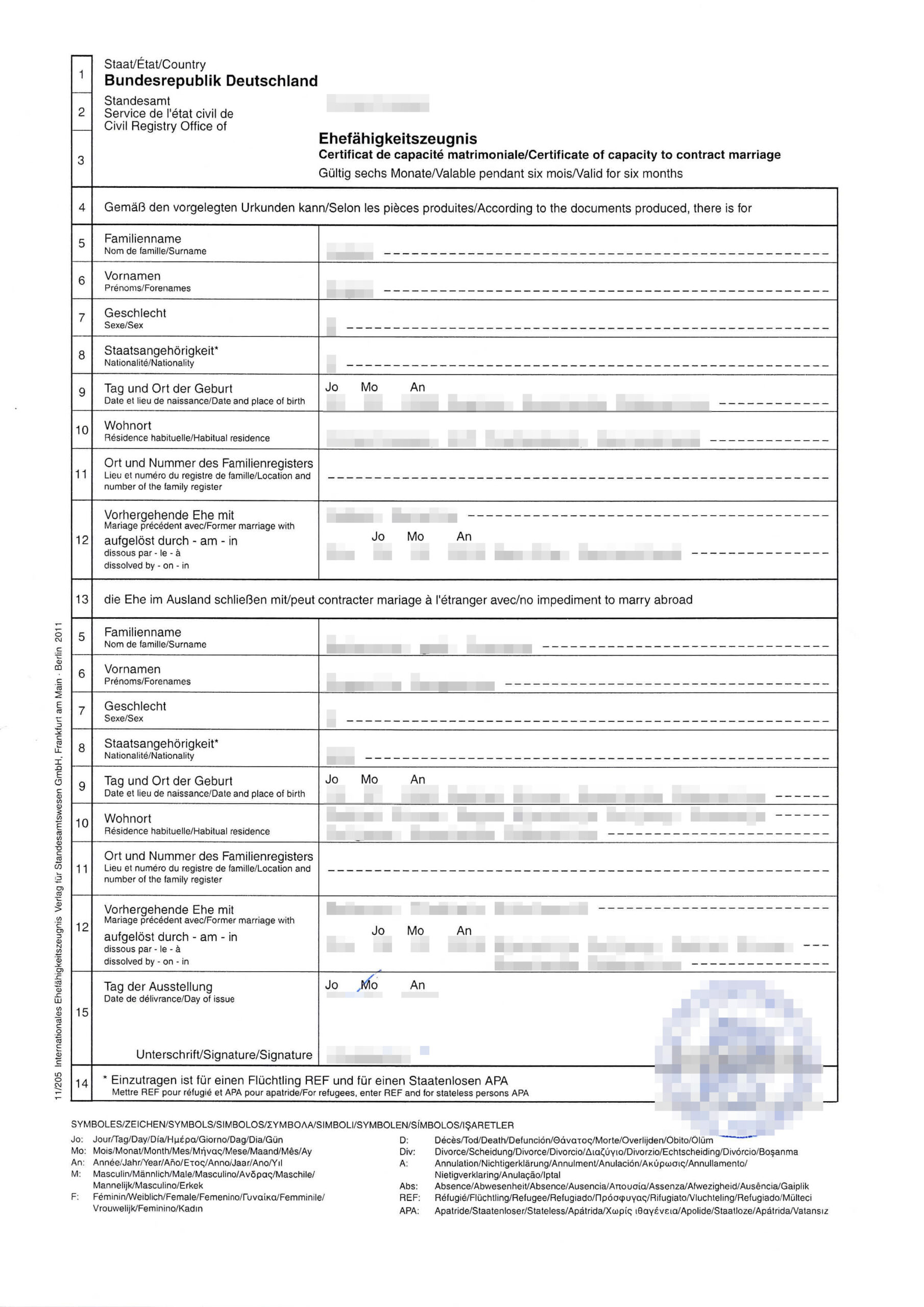
This is how the document looks like (not ours): https://www.uebersetzungsmuster.de/wp-content/uploads/2022/01/Ehefaehigkeitszeugnis_Seite_1-scaled.jpg
Consular Certificate of Legal Capacity to Contract Marriage
We then had to take the Certificate of capacity to contract marriage (Ehefähigkeitszeugnis) to the German embassy to get a so called Consular Certificate of Legal Capacity to Contract Marriage, which is basically a separate letter stating (in English) that according to the Certificate of capacity to contract marriage (Ehefähigkeitszeugnis) we can get married. As said before, the German embassy was extremely helpful and they even issued the certificate then and there in a walk-in appointment (we did not have to come back at a later date).
This is how a Consular Certificate of Legal Capacity to Contract Marriage looks like (not ours): https://i426.photobucket.com/albums/pp341/PinoyINGermany/66dad4ec.jpg).
Certification
We then had to bring the Certificate of capacity to contract marriage (Ehefähigkeitszeugnis) with the Consular Certificate of Legal Capacity to Contract Marriage to the Filipino Department of Foreign Affairs (DFA) located at ASEANA Business Park (Paranaque City) to get it certified.
In our experience with the DFA, you have to be very precise in your terminology because otherwise you will get wrong information or may even be rejected. The DFA does document authentication – this is the umbrella term for (1) attaching an apostille to a document that was issued by a Filipino authority and is supposed to be used in a foreign country and (2) certification of a document issued by a foreign authority that is supposed to be used in the Philippines.
The Certificate of capacity to contract marriage (Ehefähigkeitszeugnis) with the Consular Certificate of Legal Capacity to Contract Marriage is a document issued by a German authority (the German embassy in Manila after the Consular Certificate was attached), so it must be certified (NOT apostilled) by the DFA (see also here: https://www.apostille.gov.ph/documentary-requirements/ - No. 18 is the right category).
The requirements and process of getting a certification are described in detail here on the website of the DFA: https://dfa-oca.ph/citizens-charter/information-board-authentication/ (scroll down to title “Certification”). On the website it says it takes 20 days – in our case it took them one week just because an express treatment, which would have taken only 2 days, was not available.
After claiming the certified Certificate of capacity to contract marriage (Ehefähigkeitszeugnis) with the Consular Certificate of Legal Capacity to Contract Marriage from the DFA, this ordeal was finally over.
Passport copy of foreign partner which includes the latest arrival stamp
The foreign partner also has to provide a passport copy with the latest arrival stamp. Make sure your copy also includes the page with this stamp.
Original Birth Certificate
For the Filipina partner you can get this from the Online Application Website of the PSA (see above).
The process for the German counterpart is less easy because if you want to use German deeds/certificates in the Philippines, you have to have them legalized. In our case we were lucky as we had a legalized birth certificate already, but getting it is an annoying process:
Order the Birth Certificate from the German Registry Office (Standesamt) where the birth was registered.
Have the Birth Certificate pre-certified (Vorbeglaubigung) by the Department of Civil Status Matters in the District Regulatory Office (Abteilung Personenstandsangelegenheiten im Kreisordnungsamt) of the district of the Registry Office (Standesamt).
Have the Birth Certificate pre-certified AGAIN, this time by the Regional Council Office (Regierungspräsidium) of the district of the Registry Office (Standesamt). In our case we could ask the District Regulatory Office to do Step 2 and 3 together so we got both certifications “in one go” (took them a few weeks).
Get the twice pre-certified document translated (this can be skipped if you order a multilingual version from the registry office). You need a certified translation by a certified translator (Beglaubigte Übersetzung eines vereidigten Übersetzers). The signature of the translator further has to be apostilled (apostilliert) by the District Court (Landgericht) where the translator was certified. We went with a renowned (but costly) translation service which did this in a few weeks.
Have the document legalized by the Filipino consulate or embassy in Germany. The Consulate General of the Philippines in Frankfurt explains the process for this on their website: https://frankfurtpcg.de/authentication-employment-contracts.
What made this so frustrating was not only the various steps and the long time it took, but also how badly this process was documented online. We lost 2-3 weeks because we did not find the requirement of the first pre-certification anywhere, but went to get the second pre-certification first, which was denied.
We would strongly recommend making some calls to the offices in question about what is required and in what form - to get it right the first time.
Certificate of No Marriage (CENOMAR)
Both of us were never married before so we only had to get a Certificate of No Marriage (CENOMAR) from the PSA (see above). Please note that this has to be obtained not only by the Filipina partner, but also by the German one (in our case). The German partner’s CENOMAR basically only states that there are no records of him being married in the PSA’s registry. This is also super quick and easy to order.
Keep in mind that the CENOMAR is valid only for 6 months upon issuance and you have to get married within these 6 months. So we got this rather late in the process.
Pre-Marriage Certificate/Pre-Marriage Counseling Certificate
Both partners have to attend a pre-marriage course to obtain a Pre-Marriage Certificate/Pre-Marriage Counseling Certificate. This course is held by the Health Office of the City you want to get married in.
This is a 2h course where you learn about family planning and contraception which is mandatory for all ages (see Section 15 of Republic Act No. 10354, if anyone is interested) and quite a nuisance.
In our case we did the course at the Taguig City Health Office (here is an overview about it: https://taguig.gov.ph/wp-content/uploads/2024/01/5.-PRE-MARRIAGE-COUNSELINGFAMILY-PLANNING-RESPONSIBLE-PARENTHOODANTI-RED-TAPE-AUTHORITY-PPT1.pdf). We essentially called the city office to find out when these courses were held (can also be found here: https://www.facebook.com/photo/?fbid=150753544504898&set=pcb.150753761171543) and then just went there - no need to schedule an appointment.
The course was fully in Tagalog so the German partner did not understand a single word, but both of us got the certificate anyway.
Make sure to check if your name is correct on the certificate they issue – in our case they spelled a last name wrong.
Makati accepted our course certificate from Taguig (they accept the certificate as long as the course is conducted by the Department of Social Welfare and Development), but we suggest doing the course in the city where you will apply for the Marriage License for less complications.
Also this certificate is valid only for 6 months upon issuance and you have to get married within these 6 months. So we did this course also rather late in the process.
Barangay Certificate & Community Tax Certificate
You also have to show that you are a resident of the city where you want to apply for a Marriage License. In Taguig you have to have at least one partner’s Barangay Certificate from Taguig and in Makati you have to have one partner’s Barangay Certificate and Community Tax Certificate from Makati.
In our case: Filipina partner has residence in Barangay San Lorenzo in Makati. There is no online application for this. Barangay San Lorenzo has 2 offices - the main one in San Lorenzo Village and a satellite office in C. Palanca Street. The Barangay Certificate takes 1 business day. You can obtain a Community Tax Certificate also very quickly by going to the barangay office or city hall (you will get it a few min after you filled out the application and paid).
Applying for and claiming of the Marriage License
With all of your documents ready you (both partners together) can go to the civil registry of your city to apply for a Marriage License. We initially wanted to do this in Taguig, but at the last minute switched to Makati because for Taguig you had to make an appointment that could only be scheduled a month later (Makati has walk-in appointment).
In Makati the process in and of itself was rather straightforward. You go to the correct window of the civil registry (there is a sign where you can apply for Marriage License) and the officer first checks if your documents are complete and correct.
You can read this everywhere but we want to reiterate how crucial this is: The personal information in your documents have to match up!
We had quite some discussions because the German partner’s first name had an “ö” in it. While the German documents obviously had this in their records, all the requested Filipino documents had “oe” instead (because in Germany you can use both interchangeably, so in all applications for Filipino documents we – maybe naively - always used “oe”). In the end we could convince the officer that both forms are used interchangeably - luckily the German embassy made sure to use both forms in the Consular Certificate of Legal Capacity to Contract Marriage and in the passport you have the “oe” version of the name in the lower part of the bio page:



In any case, this shows how crucial a match of the personal data in the documents provided is.
After we paid the fee for the application of the Marriage License and the officer had validated all the documents, we were given a “draft” of the Application Form which we had to fill out with a black ball pen (bring a working one each to avoid any hassles!) – the male partner on the left side and the female partner on the right side of the document.
This is how it looks like (not ours):
https://imgv2-1-f.scribdassets.com/img/document/469185999/original/2d2f00193c/1715733015?v=1
You have to fill out a draft first which then is checked and (if needed) corrected by the officer. This is required because you have to fill out 3 copies of the application sheet (apparently even 4 copies in Taguig) with your black ball pen and you must not make any mistake. This process is surprisingly stressful. But in our case the officer even let us correct one mistake we made. In any case the draft really helps to fill the copies out properly.
Afterwards the application forms are again checked by the officer and you have to come back after about 2 weeks to claim the Marriage License (they gave us the exact date when we could come back). During this time frame a notice that you wish to get married is published in public (in case anyone wants to object) for a period of 11 days. On the date mentioned you go back there to claim the Marriage License. Then you can schedule your civil wedding with your officiator of choice.
All in all this whole process took us about 4 months to do, but it could easily have been longer if we would have needed a document examination by the German embassy in our case, which we luckily did not have to endure.
We hope that this may be of help.
Comments
Post a Comment